
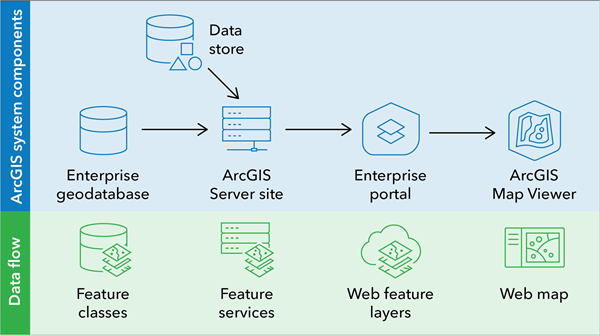
Managing an ArcGIS enterprise geodatabase effectively is critical for organizations that rely on spatial data for decision-making, analysis, and operations. Within the ESRI ArcGIS environment, optimizing geodatabase performance, ensuring data integrity, and maintaining secure access are essential components of a successful GIS strategy. This guide outlines best practices for enterprise geodatabase management, covering everything from database design and automation to integration and future-ready trends.
Below are key areas to focus on for effective geodatabase management:
1. Smart Database Design
- Organize with Feature Datasets: Group related feature classes to preserve spatial relationships and simplify data handling.
- Normalize Your Schema: Structure your data to eliminate redundancy by using related tables and establishing clear relationships.
- Leverage Domains and Subtypes: Improve data quality and streamline editing by restricting field values to predefined options.
2. Enhancing Performance
- Use Indexes Strategically: Apply spatial and attribute indexes to frequently queried fields to boost query speed.
- Compress Data Efficiently: Enable geodatabase compression to reduce storage needs and improve access times.
- Implement Versioning and Archiving: Support multi-user editing and maintain historical records by enabling version control and archiving.
3. Strengthening Security and Access
- Adopt Role-Based Permissions: Control access to data by assigning roles and permissions based on user responsibilities.
- Monitor with Audit Trails: Track data changes and user activity to ensure accountability and transparency.
- Establish a Reliable Backup Plan: Schedule regular backups and test recovery procedures to safeguard against data loss.
4. Routine Maintenance and Monitoring
- Automate with ArcPy and ModelBuilder: Use scripting and visual workflows to automate tasks like data updates, validation, and reporting.
- Conduct Regular Health Checks: Monitor database size, performance indicators, and error logs to catch issues early.
- Keep Metadata Current: Maintain detailed metadata to support data discovery and user understanding.
5. Promoting Integration and Interoperability
- Publish RESTful Services: Share data through REST services for seamless integration with web applications and external systems.
- Utilize Interoperability Extensions: Connect with non-ESRI formats using the ArcGIS Data Interoperability extension.
- Ensure Consistent Coordinate Systems: Align spatial references across datasets to prevent projection errors and misalignment.
6. Fostering Collaboration and Documentation
- Maintain a Centralized Data Catalog: Document datasets with descriptions, ownership details, and update schedules for easy reference.
- Provide Training and Clear Guidelines: Equip users with documentation and training on data standards and tools to ensure consistency.
- Manage Schema Changes Transparently: Record and communicate changes to the database schema to keep stakeholders informed.
Conclusion: Looking Ahead
Effective geodatabase management is essential for supporting spatial analysis, operational efficiency, and informed decision-making. By adopting these best practices, organizations can build a resilient and high-performing geospatial infrastructure.
As technology evolves, several trends are shaping the future of geodatabase management:
- Cloud GIS Adoption: Cloud-hosted geodatabases offer scalability, remote access, and reduced infrastructure overhead.
- AI and Machine Learning Integration: Spatial data is increasingly being used in predictive analytics and intelligent decision support systems.
- Real-Time Data Processing: The rise of IoT and sensor networks is driving demand for geodatabases capable of handling live data streams.
- Greater Interoperability: Open standards and APIs are enabling smoother integration with diverse platforms and data sources.
- Smarter Automation: Tools like ArcGIS Notebooks and enhanced ArcPy capabilities are making geoprocessing workflows more intelligent and efficient.
Staying ahead of these trends will empower GIS professionals to deliver innovative solutions and ensure their systems remain future-ready.